















Transgender rights have come under recent attack over the past year as a result of federal actions. An executive order issued by President Donald Trump last January 20 declares that “It is the policy of the United States to recognize two sexes, male and female. These sexes are not changeable and are grounded in fundamental and incontrovertible reality.” Two weeks later, Mr. Trump issued an executive order titled “Keeping Men Out of Women’s Sports” that promises to “rescind all funds from educational programs” that allow transgender athletes to compete on teams that align with their gender identity.
New York City schools continue to permit transgender athletes to compete in sports according to their gender identity. On the official website of NYC Public Schools (NYCPS), a page called “Guidelines to Support Transgender and Gender Expansive Students” states the following: “the individual student is the person who determines their own identity.”
Given the wide gulf between these federal executive orders and current NYCPS policies, The Classic interviewed THHS students and administration about the impact of recent anti-trans executive orders.
Federal policy changes and ensuing legal challenges have rapidly unfolded over the past two years, reshaping how schools interpret transgender rights. In 2024, the United States Department of Education under President Joe Biden announced changes to Title IX, a federal civil rights law that prohibits sex-based discrimination in any education program that receives federal funding. These changes explicitly extended Title IX protections to include transgender students.
Last January, a federal judge struck down the Biden Administration’s expanded Title IX policies, which prevented discrimination based on gender identity or sexual orientation to protect transgender and LGBTQ+ students. As a result, and in accordance with President Trump’s executive order, schools are now expected to follow older regulations defining “sex” as a solely biological category, excluding transgender and non-binary students from federal Title IX protections.
Months later, on September 16, the U.S. Department of Education’s Office for Civil Rights (OCR) announced their decision to discontinue their five-year grant funding for the Magnet School Assistance Program (MSAP) in NYC, maintaining support only for schools that comply with the department’s new Title IX requirements. The MSAP is a federal program that provides funding for 19 NYC magnet schools and is necessary for these schools to provide education in “cutting-edge” subjects such as math, technology, science, engineering, and architecture, as well as different types of arts.
On October 16, New York City schools sued the U.S. Department of Education (DOE), seeking to protect $47 million in MSAP grant funding.
“U.S. DOE’s threat to cut off tens of millions of dollars in magnet funding unless we cancelled our protections for transgender and gender expansive students is contrary to federal, state, and local law, and, just as importantly, our values as New York City Public Schools,” former NYCPS Chancellor Melissa Aviles-Ramos said in the news release. “My deepest commitment is to provide our magnet students, our transgender and gender expansive students, and every single student at New York City Public Schools with the ability to thrive academically and socially; to achieve that, my team and I work tirelessly to ensure every student feels seen, supported, and safe.”
The issue at hand is whether New York’s guidelines violate the new interpretation of Title IX “by allowing NYCPS transgender students to use bathroom, changing room, and locker room facilities; participate in athletic activities; and be provided with overnight accommodations on school trips, consistent with their gender identity.”
As the question plays out in the courtroom, school faculty and transgender and nonbinary students have expressed frustration over the current cultural climate surrounding transgender and nonbinary students’ rights.
THHS freshman Jammy Chen said, “These changes make me feel sad for all transgender students around America because they will have their right to participate in activities according to their gender identity stripped from them.”
A transgender student at THHS, who asked to remain anonymous, described the situation as a “slippery slope” and said the current wave of policy changes has deeper implications for vulnerable communities “because if they come after the rights of trans people, then they’re going to end up coming after the rights of other marginalized communities very quickly after that.”
With these recent changes that threaten the rights of transgender and nonbinary students, some administrators believe supports and resources for students affected should increase.
Assistant Principal of Organization Ellen Fee said, “I think checking in [with transgender and nonbinary students] at minimum is a good idea. And I think we can hear best from the students themselves, what kind of support do we need to add? … I don’t think we have singled out trans students as needing more support than any other student. So, that might be something that we could work on.”
Ms. Fee shared her experience as a parent of a transgender student: “For my son, the bathroom situation was one of the most important issues during his transition. Feeling safe in that space mattered deeply to him, and he always preferred using a single-stall bathroom whenever possible. It allowed him to simply go in and out without anyone questioning or noticing his gender.”
“If laws were to change and require transgender people to use the bathroom of their assigned sex at birth, it would be distressing not only for the transgender person but also for others in the bathroom who might be confused or uncomfortable,” Ms. Fee said. “It forces everyone into an awkward and painful situation, treating someone as one gender everywhere else but suddenly as another in the bathroom.”
Despite the federal executive order aiming to limit transgender participation in women’s sports, the Office of the Attorney General and the New York State Education Department have reaffirmed their commitment to upholding the Gender Expression Non-Discrimination Act and “offer robust protections for transgender students, including the right to use facilities (such as restrooms and locker rooms) and to participate on athletic teams that align with their gender identity.”
Current Public School Athletic League (PSAL) regulations for transgender and gender expansive student-athletes affirm that “a student must be permitted to participate in physical education, intramural sports, and competitive athletic activities and contact sports in accordance with the student’s gender identity asserted at school.”
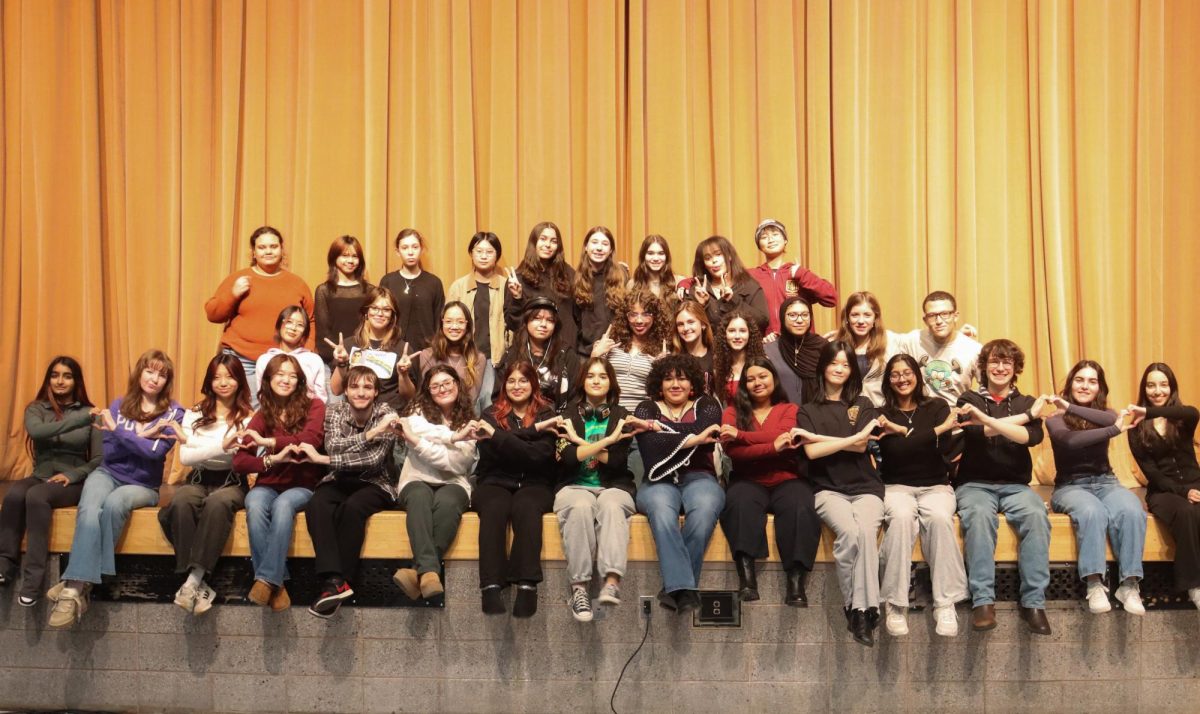
Many students have identified THHS as one of the more supportive schools, describing it as “inclusive” and “welcoming.” One of the many supports that THHS currently offers is the Gender Sexuality Alliance (GSA) club. The GSA club provides a safe space for LGBTQIA+ students and is open to anyone in the school community. Their goal is to create a community where people can learn, grow, accept, and advocate for each other.
GSA President Aki Benjamin, a junior, said, “I do believe the school should be willing to provide whatever support any student needs. Specifically, I think counselors being available…and a push by the school to have all students recognize one another’s shared values and identities are both very important. … [Additionally], there could always be more communication about LGBTQIA+ protections and rights.”
Members of the faculty have expressed their commitment to creating an environment where all students feel safe at school.
GSA advisor and Respect for All liaison Alison Harris said, “I’ve helped students who have been struggling with identity and how to navigate that process. Usually talking it out helps a lot when they know that there is someone with a listening ear [who] cares for them.”
Guidance counselor Sara Skoda said, “We’ve all worked on trying to ensure that students are and remain fairly treated at our school, despite what’s happening nationwide. So I think that we do try to make sure that everyone knows there is a safe space for them at all times here in our school.”
Dean Ian Morzan said, “There’s a whole team of people that are here to support, and that’s on the proactive end, if there’s something that has occurred that the student doesn’t feel well about, there’s a whole other group of people that are here at the school to help them, whether that be deans, or the respect for all liaison, but there are supports for both ways.”
Despite the recent federal changes regarding trans rights, the GSA and the rest of the THHS community have said they will continue to support the identities of all students. “The GSA will always be here to both provide a safe space for all students and advocate as necessary to administration,” said Aki.
According to a student who describes themself as queer and also asked to remain anonymous, a safe space is especially important in the current political climate. “This time has been really turbulent recently, considering just the past year in general, and we need community and support more than ever,” said the student. “[People’s] voices are being silenced when voicing support for queer folk.”