
![Incoming Student Union President junior Aki Bejamin and other SU candidates sitting on stage while waiting to give their speeches during the May 18 SU Debate. Aki said he plans to “burn [the SU] all down and start anew.”](https://thhsclassic.com/wp-content/uploads/2026/06/IMG_9600-e1782439128607-1200x1131.jpg)











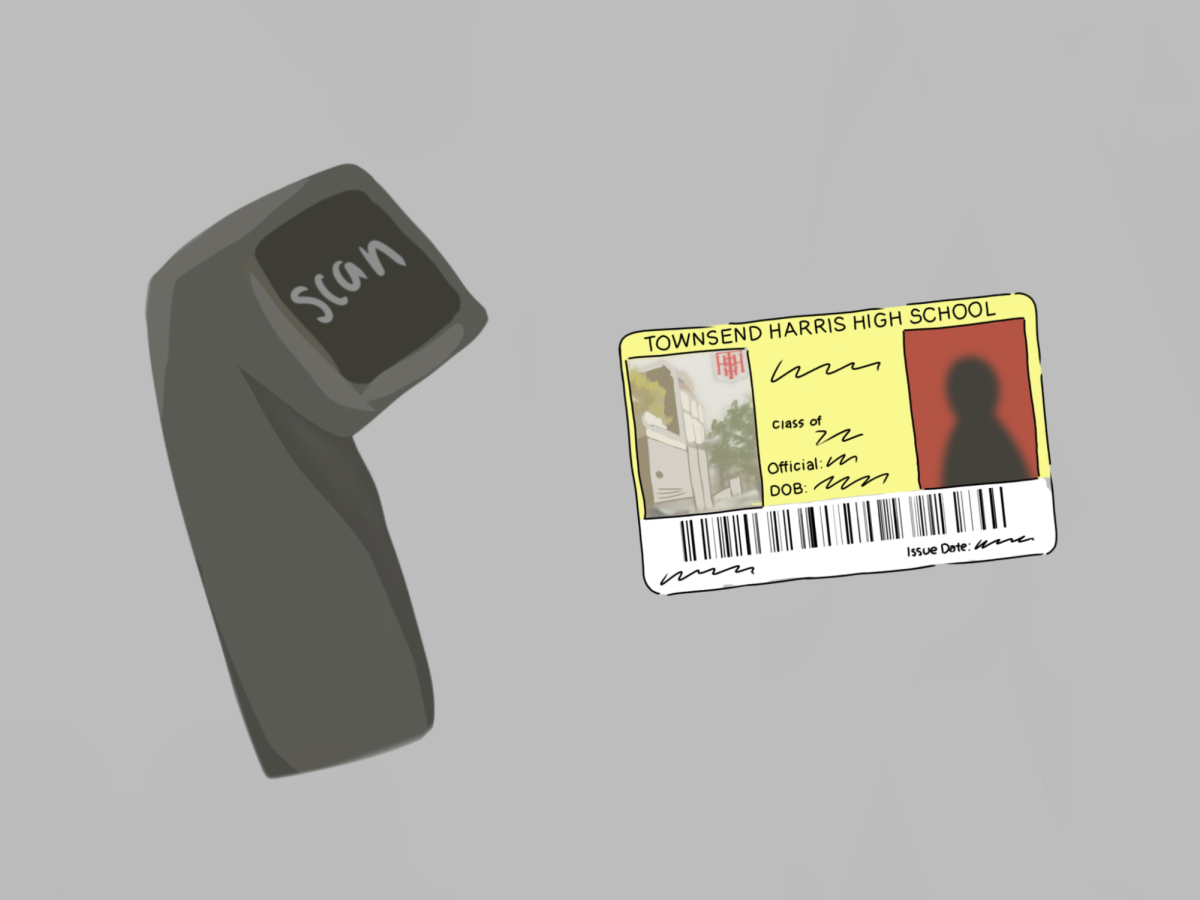


Townsend Harris High School’s student identification system has evolved over the past two decades from paper program cards and Queens College IDs to color-coded cards, barcode scans, and digital entry records.
Sarah Loew, a science teacher and 2006 graduate from Townsend Harris said, “we actually had a program card just like you guys do, like a sheet of paper that had our name and our program on it, and you had to have that piece of paper every day to get into the building.”
Ms. Loew said students who did not have their program cards likely had to write their names down and could receive demerits after repeated incidents.
Students also received Queens College IDs during freshman year, Ms. Loew said. The cards had student photos and were used to access Queens College facilities, including Rosenthal Library. They were not, however, the main form of identification used to enter Townsend Harris. “That wasn’t the appropriate form of ID that the Townsend Harris security safety agents needed to see,” Ms. Loew said.
The next major shift came when Townsend Harris began requiring students to wear school-issued IDs around their necks. Christopher Amanna, a Latin teacher who graduated from Townsend Harris in 2006, said the rule was introduced while he was a student and was met with pushback. “This was a completely new policy,” Mr. Amanna said. “We’d never had security policies like this before.”
As a student, Mr. Amanna co-wrote an opinion article criticizing the policy. He described the policy as “unjust” and “ridiculous.” Looking back, he said much of the frustration came from the way the change was introduced. “I’m sure the administration had a reason for it,” Mr. Amanna said. “But it was never really conveyed to us why we needed this extra level of security.”
For Mr. Amanna, one issue with the old system was that the IDs were not effectively checked compared to the kind of digital verification system used today. “Back in my day, you were just flashing a piece of plastic,” Mr. Amanna said.
In the next shift, students were required to show their color-coded IDs in the morning.
Physics teacher John Tsai, who helps manage the school’s technology and ID production, said that the basic Townsend Harris ID design began around 2004 and has remained mostly the same, though colors were added later. Each incoming class receives a color and keeps it until graduation. Before CAASS, the Comprehensive Attendance, Administration and Security System, the colors helped staff identify grade levels more quickly.
School Safety Agent Pamela Pierce said that even with the new CAASS system, the color and year on the cards still help her determine what grade a student is in.
Today, student IDs are not only shown during morning entry, they are scanned and logged. According to Mr. Tsai, Townsend Harris ID cards are connected to a DOE-managed system. He said the DOE owns student data and stores it through a cloud-based system.
“The DOE owns the data,” Mr. Tsai said. “Everything’s held in the cloud now. And all we do here is take pictures of the students and then that’s uploaded to the cloud also.”
The cards also include barcodes assigned through the DOE system. Mr. Tsai said when a student receives a replacement ID, the previous card is unusable, preventing a lost card from being used to scan into the building. “If they lose their ID, when they get the next one, it invalidates the other one,” Mr. Tsai said.
Principal Brian Condon said CAASS has been the biggest change to student identification during his time as principal.
“Prior to [CAASS], we didn’t have anything like that, so we had to rely on visual identification by the people that read entry or the people that were at the back door for kids coming in and out,” Mr. Condon said.
According to Mr. Condon, CAASS does not directly determine official attendance in Jupiter or the DOE attendance system. Instead, it creates a separate record showing when a student entered the building. “All CAASS tells me is who walked in the building when,” Mr. Condon said.
If a student arrives late, CAASS prints a pass showing the time the student entered the building. Mr. Condon said that pass helps teachers determine whether a student came directly to class or spent time elsewhere first.
Tim Connor, a dean, similarly said that CAASS helps the school answer questions that were harder to answer under older systems. “It’s knowing who is in the building, and when they got here is the major reason,” Mr. Connor said.
Mr. Connor said the system can also help staff respond to parent questions, track repeated lateness and locate students more efficiently when needed.
The system, however, is not used the same way at all times. During morning arrival, students scan in. After school, students generally show their IDs visually. Agent Pierce said CAASS requires administration or designated staff to operate the machines. “Any time they have to use the CAASS machine, they need to have the administration here,” Agent Pierce said.
Mr. Condon said the school has dealt with ID misuse. “We’ve had underclassmen somehow get a hold of upperclassman’s ID so that they could leave the building,” Mr. Condon said. He said staff often catch those situations because the IDs are color-coded by class year.
If a student from another school enters or attempts to enter improperly, Mr. Condon said Townsend Harris works with that student’s home school through DOE reporting procedures. If an adult entered without permission, or if a serious incident occurred, he said the response could involve detainment or arrest. Even with those concerns, Mr. Condon said Townsend Harris remains a low-incident school.
Though CAASS provides increased safety measures, some students question the need for the switch. Senior Muntakhab Hossain said, “the current ID system is unnecessary given how well students complied before the system was introduced.”
Sophomore Maggie Gildea said, “While I’ve heard some people say that the new ID system sometimes can delay entering school, I think that it encourages safety.”
Similarly, sophomore Evan Lianos said, “I like the new id system because it promotes safety and clear guidelines about attendance. Additionally it establishes a need for self responsibility.”
Looking ahead, Mr. Condon said CAASS works well but could be improved. He said smaller handheld devices and stronger reporting tools could make the system easier to use.