





























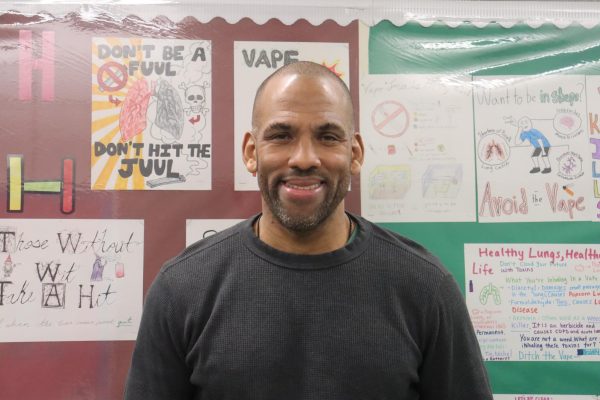
As I slung my bag off of my shoulder, and took a seat in class at the start of the school year, I listened to the teacher give us a summary of my new class: Financial Literacy. I let my mind wander as he spoke, promising myself I’d head to guidance to change my schedule as soon as this class was over. Financial Literacy wasn’t my first choice as an elective, and I was eager to see if there was space for me in another AP course. My eyes were focused downward while I twiddled my thumbs and listened as financial literacy teacher Jamal Bermudez continued to tell us what the course would entail. However, when he began to ask the class why each of us decided to take the course in the first place, my eyes darted up.
Immediately, the question reminded me of my early morning car rides to school with my dad. Our routine was consistent: listening to videos about digital currency. I had picked up a few terms by now, such as Bitcoin and XRP, and I began to understand concepts such as what it meant for a digital coin to go up or down in value. So, as soon as Mr. Bermudez raised the question, my hand shot up. I shared with the class that while I could make sense of what was going on in the videos my dad and I would listen to each morning, I wanted to learn more for myself and what it meant to invest. Mr. Bermudez validated my interest in learning about digital currency, and assured me that it would be a part of our year’s curriculum.
In the end, the opportunity to switch out of financial literacy was offered to me by my guidance counselor in exchange for being enrolled in another AP course. However, I decided to stay enrolled in financial literacy, and I couldn’t be happier with the decision.
One topic discussed in class was that there are many government officials, organizations, and schools working hard to get legislation passed so that financial literacy can be taught across the country. Many bills have been introduced, specifically in New York, that would require financial literacy to be taught statewide. One bill that was introduced in 2025 is Senate Bill S95, which would ensure topics such as financial planning, budgeting, borrowing, interest rates, and personal insurance policies would be taught to all students grades 9-12.
It is integral that bills like Senate Bill S95 get passed because learning how to save, invest, spend, and borrow money is crucial to success. Many young adults are expected to apply for student loans in order to pay for college, apply for a debit or credit card, or sign a lease to pay for a car or apartment. They are expected to adopt all of these responsibilities without ever properly being taught about how to handle their finances.
We cannot expect teenagers who have just graduated from high school to make sound, financially smart decisions that have a long-lasting impact on their future finances, when our education system has not made it a requirement for students to be taught about it. Students should be learning how to become financially literate while still in high school so that they have the required skills they need to be financially smart when they step into the real world.
According to CNBC, a study done by the Financial Industry Regulatory Authority’s Investor Education Foundation found that those who were required to take a personal finance course in high school had higher credit scores as adults, as well as lower debt delinquency rates.
In one survey, one in five student loan borrowers said that they borrowed more than they needed to pay for a higher level of education simply because it was offered to them. Additionally, in a survey conducted by the New York City government, 28 percent of participants weren’t sure what kind of student loan repayment plan they were participating in.
Currently, 30 states require that students take a personal finance course before graduating from high school. It’s time for New York state to become part of the sixty percent of the country that requires students to become financially literate too.