![Incoming Student Union President junior Aki Bejamin and other SU candidates sitting on stage while waiting to give their speeches during the May 18 SU Debate. Aki said he plans to “burn [the SU] all down and start anew.”](https://thhsclassic.com/wp-content/uploads/2026/06/IMG_9600-e1782439128607-1200x1131.jpg)

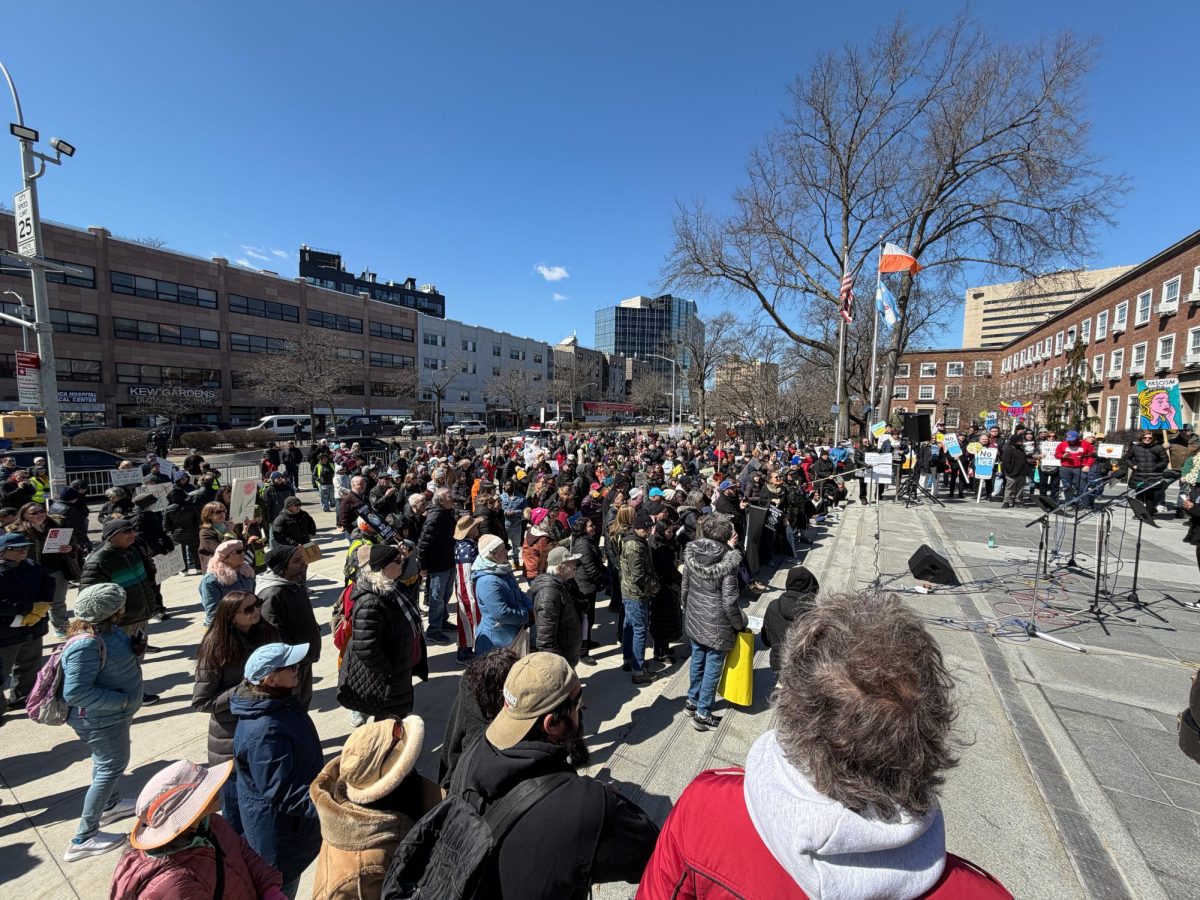









With a modern civil rights protest movement growing in Minnesota, Queens Borough President Donovan Richards spoke on January 18 at Queens College’s annual Martin Luther King, Jr. Day Celebration, casting the Trump administration’s first year in office as a direct threat to the civil rights movement that is Dr. King’s legacy.
Describing ICE agents as unjustly attacking “our brothers and sisters” in Minneapolis, Richards called for action. “We in Queens are not going to sit idly by while they try to take away the hard fought gains of the Civil Rights movement,” he said at Queens College’s Goldstein Theatre. “The great progress we’ve made is now being undermined. What we are seeing coming out of Washington…is a slap in the face to all that Dr. King stood for.”
Richards accused the Trump administration of working “tirelessly to erase Black history and to kneecap the future of our Black community,” adding, “They are terrified of Black expression at the ballot box. They’re intimidated by Black excellence, [and] they cringe at the thought of Black leadership.” He closed by saying, “May we all stand firmer together, and I’ll believe that the dream that Dr. King had is still alive. They might have killed the dreamer. They have not killed the dream.” His last line prompted applause and cheers from the audience in the filled theater.
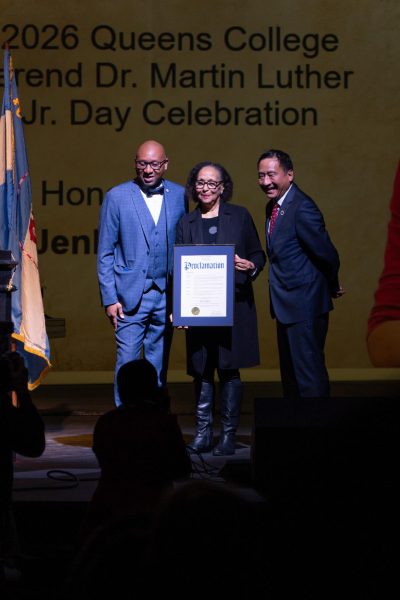
(Ryan Chen)
In addition to Richards’ speech, the event featured speeches from both college and local officials, and a keynote from activist and television host Carol Jenkins, who received the Queens College Rev. Dr. Martin Luther King Jr. Award. The afternoon concluded with a jazz performance by award-winning vocalist and musician Tyreek McDole.
The theme of this year’s event was “Where do we go from here?” It was inspired by Dr. King’s book of the same name, which focuses on service, responsibility, and unity.
In her speech accepting her award, Jenkins also addressed current events.
“For some of us in this country, we’re in a state of grief, of fear, of uncertainty” she said, focusing on concerns about the media, immigration, and colleges. “We see academia under threat. We see immigrants, like the rest of us, who have all been immigrants in one way or another, under threat.”
Jenkins, who during her journalism career covered events such as South African political leader Nelson Mandela’s release from prison, centered her remarks on Dr. King’s beliefs about human rights, focusing on the sustained presence of poverty in America. “[Dr. King] felt that what was at the base of this country’s disease … was the fact that people could not eat.”
In his opening remarks, Queens College President Frank Wu discussed the college’s long-standing connection to Dr. King’s legacy, dating back to Dr. King’s 1965 speech at Colden Auditorium. Wu described the event as a reminder that despite progress since Dr. King’s visit, there is a lot more to be done to uphold his legacy. Following his remarks was a performance of The Black National Anthem by vocalist Asima Leonard and pianist Nathan Fry.
The event featured the sixth installment of the school’s MLK Day video series, created and produced by Queens College’s Office of Communications and Marketing. Jay Hershenson, Vice President of Communications and Marketing and an alumnus of Queens College, began the series in 2021. This year’s video showcased Queens College’s commitment to expanding access to education through the Search for Education, Elevation, and Knowledge (SEEK) program. The program aims to “reach qualified high school graduates that meet the financial requirements, that may not attend college otherwise.”
Another speaker, Lorraine Lewis, CEO of Long Island Jewish Hospital Forest Hills, spoke about a similar program she attended for medical school known as CUNY Sophie Davis, a school that aims to increase the number of historically underrepresented physicians through their affordable combined degree program. She said there’s a connectedness between Martin Luther King Jr. and “folks like us in healthcare,” saying that accessible healthcare is as important as accessible education.
The latter half of the event shifted to a performance which Lewis introduced in her speech: “Naomi Tutu [said]…in the middle of all that hardship, they still had joy. And as we are about to be here and listen to Tyreek McDole, that’s joy.”
The performance was led by vocalist Tyreek McDole and his quintet, consisting of himself, Caelan Cardello, Dylan Band, Dan Finn, and Gary Jones III. The group played tracks from McDole’s debut album Open Up Your Senses.